The Weekly Nerd

May 10-16 2026
It’s a quieter astrology week than the last one which is probably for the best since it’s Mother’s Day and every restaurant in existence is about to become absolute chaos.
If you haven't bought your mum a gift or made reservations at a restaurant, well, what are you waiting for? Go do that now! Hurry, before it's too late!
The Sun sextile Jupiter will give us a pleasant, and perhaps adventurous, Mother's Day. You might book a flight for your mum, or even just take her out to a new restaurant she's never been to before. But seriously, I hope you made reservations because everybody and their mother (literally) are going to be out tonight.
After we see the transits, we'll take a look at the various approaches to astrology and the techniques used in the weekly article.
We have some great celebrity birthdays, like Bono of U2, and for the recommended book this week, I'm going to tell you about the book that helped me understand the astrological "aspects" better than anything else.
Did you make those reservations yet? Go ahead, I'll wait.
You're back then? Great, let's continue. I hope you enjoy this issue of The Weekly Nerd. Now, let's have a look at the transits of the week.
Transits of the Week
May 10 - Sun sextile Jupiter 07:14 AM MST
This is a good time for broadening your horizons. You feel expansive and you want to get out and experience life. The extent to which you're able to do this depends on your circumstances. It could be anything from booking an international flight to a weekend getaway nearby, or even just exploring a new part of your town.
May 12 - Mercury sextile Jupiter 9:44 PM MST
Like with the Sun sextile Jupiter, this one, too, is expansive, but more of the mind than anything else. You may have big ideas about something to do in the near future. You're excited about your plans, but unlike with the trine, the sextile doesn't tend to make your thoughts expand out of control. You might also be in the mood to talk philosophy, religion, or politics, or you might want to read or discuss foreign cultures.
May 14 - Mercury conjunct Sun 07:25 AM MST
When this transit occurs it means that Mercury retrograde is not far away. Mercury has now caught up with the Sun and will start moving ahead of it. Since Mercury cannot be more than 28 away from the Sun, an approaching retrograde is inevitable.
This transit fuses thought with ego, inclining people to be extra chatty at this time. Everyone has something to say and people interrupting you mid-thought is likely. You might even do some interrupting yourself. Everyone identifies with their thoughts to some extent. We often feel like those thoughts are us, even though this is not true. During this transit, though, we are even more likely to identify with what we think and say, and we believe it is the most important thing anyone has ever thought or said.
Weekly Article: You Practice Astrology? Which One?
The title of this article may be confusing. You might be asking, "Which one? What do you mean 'which one'? You mean there's more than one astrology?"
Yes, indeed, there is more than one astrology. Or rather, there is more than one way it is approached. And not just the focus, but even the techniques. Let's start with the most significant difference between two completely different ways of doing astrology.
Tropical Versus Sidereal
Did you know there are two different zodiacs? Which one you use makes a big difference in how you'll read a birth chart.
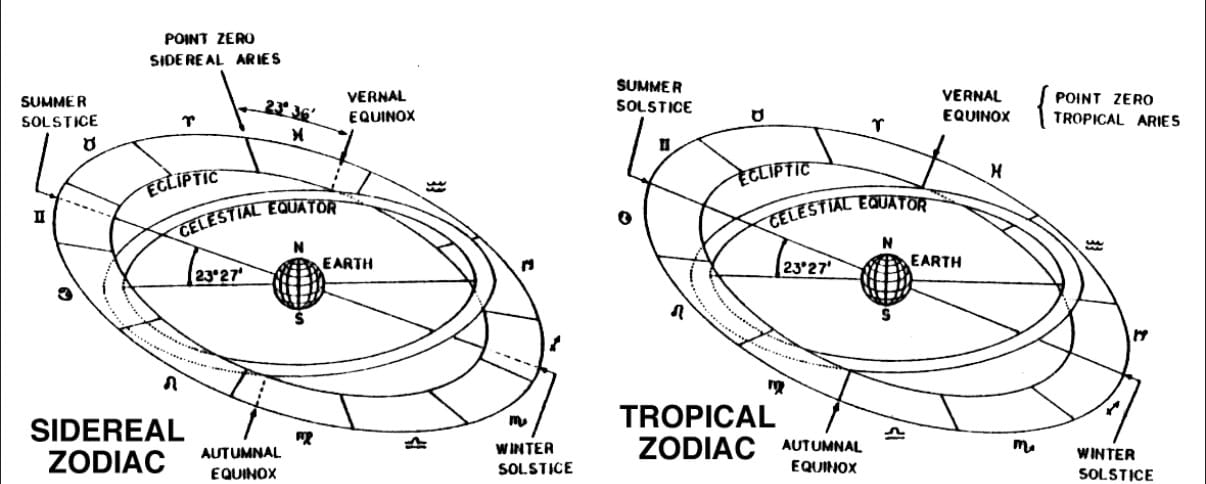
In modern, Western astrology, we mainly use something known as the tropical zodiac. Vedic astrology, the kind practiced in India, uses the sidereal zodiac. Okay, so what's the difference?
Precession of the Equinoxes
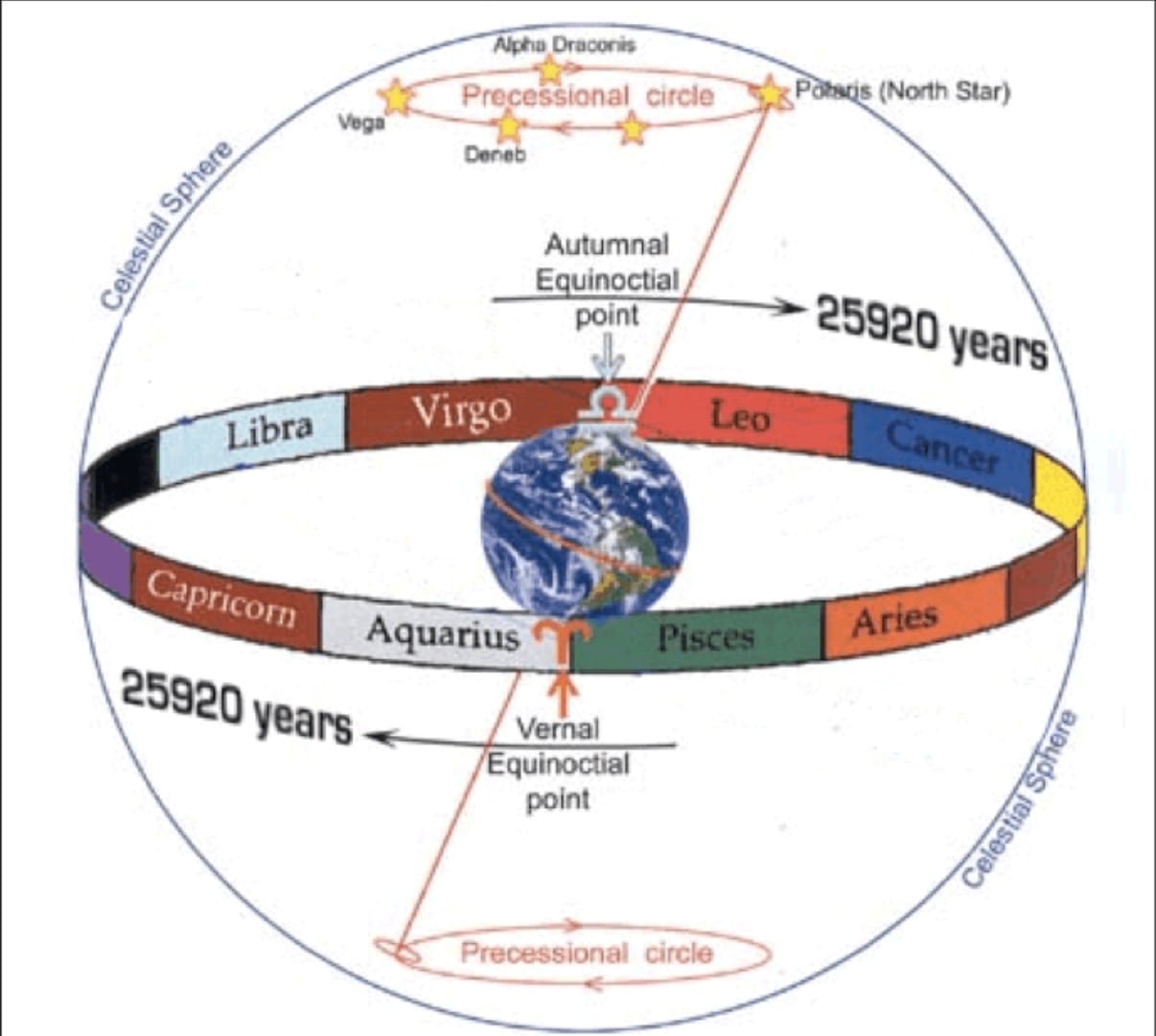
When astrology was first getting started in ancient Mesopotamia, approximately 2,000 BCE, the constellation of Aries began the year on the first day of spring.
The first days of spring and autumn occur at the two equinoxes. At these two times, day and night are of equal duration. The word "equinox" is Latin for "equal night".
At this time, the constellation we call Aries roughly lined up with the vernal equinox on 21 March. But there is something known as "the precession of the equinoxes" which has completely f#cked all this up.
You see, Earth spins on its axis, like a spinning top, tracing out a circle in the sky. This wobble causes the constellations to shift slowly over time, completing a full cycle roughly every 26,000 years.
There are a few different ways to calculate this that are known as "ayanamsas". The most commonly used one in the West is the Fagan-Bradley Ayanamsa. Each method produces a slightly different result, but the goal is the same: to predict the future drift of the constellations along the ecliptic.
What this all means is that the constellation of Aries no longer lines up with the Vernal Equinox. Nowadays, the constellation of Pisces lines up with it instead. At some point in the future (exactly when is hotly debated) the vernal equinox will line up with the constellation of Aquarius. This will begin the so-called "Age of Aquarius" you may have heard about. Some say we're already in it, but the Fagan-Bradley Ayanamsa says we still have a few centuries to go.
Okay, so what is the tropical zodiac then? The tropical zodiac dispenses with the use of the constellations and simply divides up the sky into 12 equal sections. These pieces of sky are named after the constellations but do not correspond with them.
Whereas the constellations are constantly moving westward, the signs remain where they are. The constellation of Aries no longer lines up with the vernal equinox but the sign of Aries does and always will. In the tropical zodiac, 0° of the sign of Aries lines up perfectly with the equinox. That is why Aries always starts on 21 March, but it is the sign, not the constellation, that does this.
Western astrologers, like myself, largely use the tropical zodiac whilst Vedic astrologers prefer the sidereal one. In the tropical zodiac, I'm a Pisces whereas in the sidereal zodiac I'm an Aquarius. Which one is correct? Well, I feel like Pisces is, but that might just be because I'm biased toward the tropical zodiac.
Geocentric Versus Heliocentric
If the two different zodiacs weren't enough to confuse you, there are also two different focal points from which to place your horoscopes (birth charts). They are geocentric (Earth-centered) and heliocentric (Sun-centered). Most astrologers, both Western and Vedic, use the geocentric model, though some like to use both. The geocentric model is more popular because, well, we're on the earth and so this is the viewpoint from which we see the sky.
Heliocentric is, of course, more scientifically accurate, but since we're not seeing the planets from the surface of the Sun, geocentric remains the favored model for most astrologers. The heliocentric model, of course, necessarily dispenses with the houses, since the houses are a division of the local sky from our viewpoint on Earth.
Classical Versus Modern
In the 1990s, Project Hindsight, a large astrological research project, started the laborious process of translating hundreds of ancient texts on astrology into English. The goal was to find out how ancient cultures, like the Egyptians, Greeks, and Romans, for example, actually did astrology. Did theirs look like ours at all? Or was it completely different?
The results showed a bit of both. There are many aspects of astrology that have remained unchanged through the millennia, however, there are also quite a few differences. Thus began the whole "classical versus modern" debate that continues to this day.
Project Hindsight showed that a lot of classical techniques have become lost in modern astrology. Proponents of the classical view have worked to reintegrate those older techniques back into modern astrology. The concept of "essential dignity" (a system for determining planetary strength), for example, was largely forgotten until Project Hindsight brought it back. Many astrologers, like myself, now use a mix of both classical and modern techniques.
The House Systems
In a previous issue of The Weekly Nerd, we looked at the different types of house systems and advantages and disadvantages of each, and discussed why this question of house division hasn't been settled by now.
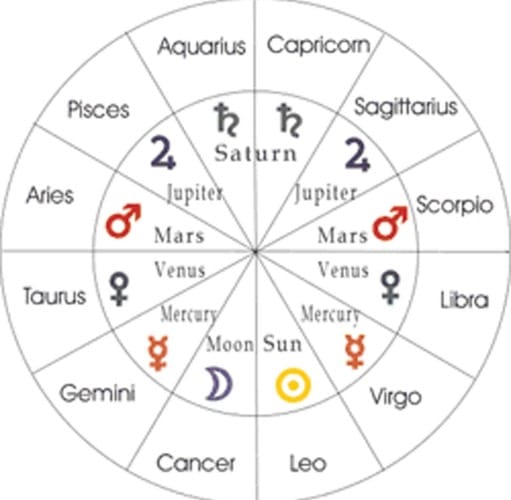
I'm not going to rehash all that here, but I did want to mention how the different house systems play into these different types of astrology. As an example, Project Hindsight brought back the previously popular (in ancient times) house system known as "whole-sign" houses. Vedic astrologers also favor this house system. Western astrologers, like me, were often taught with Placidus or another quadrant house system and so we became comfortable with that.
A lot of younger astrologers, who started learning after the 90s, have fully embraced whole-sign houses. This is the system they started with and so, naturally, the one they feel most comfortable with.
Over the years, though, house systems rise and fall in popularity and so this debate is hardly over. I suspect that astrologers a century from now will still be arguing over which house system to use.
Other Considerations
Beyond the different approaches to astrology, there are a wealth of other techniques astrologers use, some more common than others. Some of us like to include asteroids, comets, and other astronomical points or bodies, like Chiron and Black Moon Lilith, and some even like to work with hypothetical or "Trans-Neptunian" planets.
There are also the nodes of the Moon and points in space like the vertex and east point. Some astrologers like to use the "Arabic parts" and others like to play with techniques like converse directions and diurnal charts. I am especially fond of diurnal charts, myself, though for some reason they are not commonly used.
So, if you're interested in becoming an astrologer, yourself, you have many choices to make about the type of astrology you want to practice and which techniques you would like to use. For example, I don't mess with the asteroids, myself, nor do I use Arabic parts, and I know nothing about the Trans-Neptunian planets. I feel like I already have plenty of techniques to use in my astrological toolkit that I have no need for those other ones. To me, they just make everything more complicated without adding much more to the interpretation.
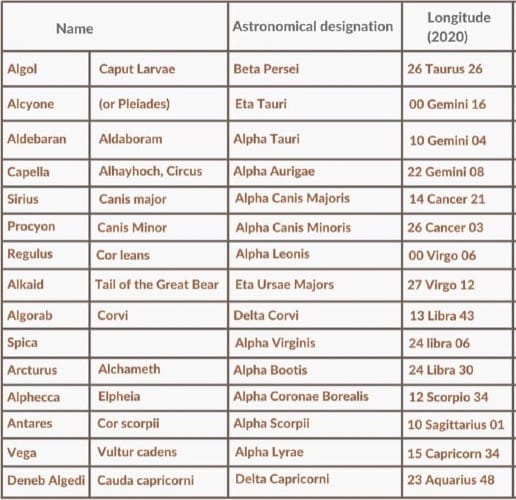
But to each their own, and you are certainly welcome to use any techniques you wish. You might want to use asteroids or fixed stars. You might wish to use the sidereal zodiac, or experiment with heliocentric charts. Perhaps the classical techniques will speak to you, or maybe you have an interest in learning Vedic astrology.
Whatever path you choose to travel in your study of astrology, learn as much as you can. In my opinion, the exact techniques an astrologer uses are less important than their knowledge and experience. Whichever types of astrology call to you, strive for competence, excellence, and ethical practices.
Shea (The Astrology Nerd)

Celebrity Birthdays
May 10 - Bono (66)
Charismatic frontman for U2.
May 11 - Martha Quinn (67)
One of the original MTV VJs
May 12 - Rami Malek (45)
Actor most known for playing the late Queen frontman, Freddie Mercury


Rami Malek as the spitting image of Freddie Mercury (left) and in real life (right)
May 13 - Stevie Wonder (76)
Legendary musician with a career that spans decades and 25 Grammy Awards
May 14 - Cate Blanchett (57)
Australian actress known for her role in The Lord of the Rings trilogy
May 15 - Andy Murray (39)
Professional tennis player with 2 Olympic gold medals and 2 Wimbledon victories
May 16 - Megan Fox (40)
Actor best known for her role in the Michael Bay Transformers movies
Recommended Astrology Book of the Week
Aspects in Astrology by Sue Tompkins
This was the book that helped me learn aspects more than any other.
Learning the aspects can be tricky. Compared to learning signs and houses, aspects can feel overwhelming. I had read other books about aspects before this one, but Aspects in Astrology is the book that really helped me master them. I would give it 5 out of 5 stars. Highly recommend.
And that’s the end of The Weekly Nerd for this week. I hope you enjoyed it. Watch your inbox next Sunday for another one.
Have a wonderful week! And if no one has told you yet today, you are important and the world needs you.
Bye for now.
Shea (The Astrology Nerd)
Hey, did you know you can reply directly to this email? Yep, you can. And I’ll receive it in my inbox. Feel free to reply with questions, comments, suggestions, your favorite recipes, pictures of your pets, marriage proposals, your plans for world domination, whatever.
Hey, did you know you can reply directly to this email? Yep, you can. And I’ll receive it in my inbox. Feel free to reply with questions, comments, suggestions, your favorite recipes, pictures of your pets, marriage proposals, your plans for world domination, whatever.
Want to work with me? Become one of many satisfied clients.
I do general chart readings as well as predictive readings, like transits, progressions, solar arc, and even solar return (birthday) charts. See the services I offer here.
If you're interested in a one-on-one session with me over Zoom, click below to see my availability.
Don't see a day and time that works for you? You can always email me and ask if I can accommodate you. I may be able to schedule outside of my normal times. Just ask. Ready to book? Click the button below and I'll see you soon!
©️ 2026 The Astrology Nerd
This publication may be shared but not sold or altered in any way. Written by Shea Ballard. Photos from Canva or Pixabay.